
Blog ·
Bidet Seat Water Filter OEM: Fittings, Specs & MOQ | XZH
Bidet seat filter sourcing for brands: 7/8-inch vs G1/2 fittings, 125 psi rating, cold-line limits, PP media and label claims. MOQ 500 pcs. Get a free sample.
Short answer: A bidet seat filter is a small sediment filter on the cold-water inlet of an electronic bidet seat. Its job is to protect the seat’s solenoid valve, heater and nozzles, not to purify water. When you source one for your own brand, five things decide whether it works in your customers’ bathrooms: the connection for your market (7/8-inch ballcock in North America, 1/2-inch BSP threads in most other markets), the direction of flow, the pressure and temperature rating (ours: 0.1-0.862 MPa / 15-125 psi, 4.4-37.8 °C, cold line only), the micron rating (5-10 µm PP is standard) and the claims on the box. The replacement interval is 3-6 months, which is why filters sell as a repeat item.
We manufacture bathroom and bidet seat inline filters in Ningbo alongside our under-sink and commercial cartridges. This guide covers what we see go wrong on the factory side: wrong threads, reversed flow and claims that get listings pulled.
Why Bidet Seats Need an Inlet Filter
An electronic bidet seat is a small water appliance sitting on a toilet. Inside it there is a solenoid valve, a flow or pressure regulator, a tank or instant heater and one or two spray nozzles with very small openings. All of these sit directly on the building’s cold-water supply, usually tapped off the toilet’s angle valve.
That supply is not as clean as people assume. Every time a water main is repaired, a riser is drained or an old galvanised pipe flexes, sand, scale and rust flakes come loose. In many Asian and Middle Eastern cities, customers also find red worms (midge larvae) in their water. None of this is a health problem for flushing a toilet, but it is exactly what jams a small solenoid.
| Failure in the field | Typical cause | What the customer sees | Does an inlet filter help? |
|---|---|---|---|
| Seat drips water into the bowl when idle | Particle trapped on the solenoid valve seat | Constant trickle, “running toilet” complaint | Yes, the main reason to fit one |
| Weak or uneven spray | Nozzle or flow regulator partly blocked | Poor washing, returns for “broken pump” | Yes |
| Heater error / slow warm-up | Scale and debris in the heater tank | Error code, lukewarm water | Partly: a sediment filter stops debris, not dissolved hardness |
| Leak at the hose joint | Wrong thread or missing washer | Water on the floor | No, this is a fitting-specification issue |
| Filter bursts or cracks | Installed on hot line or above rated pressure | Flood, damage claim | No, this is a rating and instruction issue |
The table shows the first sourcing lesson. A filter protects the seat from particles, but half of the field failures we are asked about come from fittings and instructions, not from filtration.
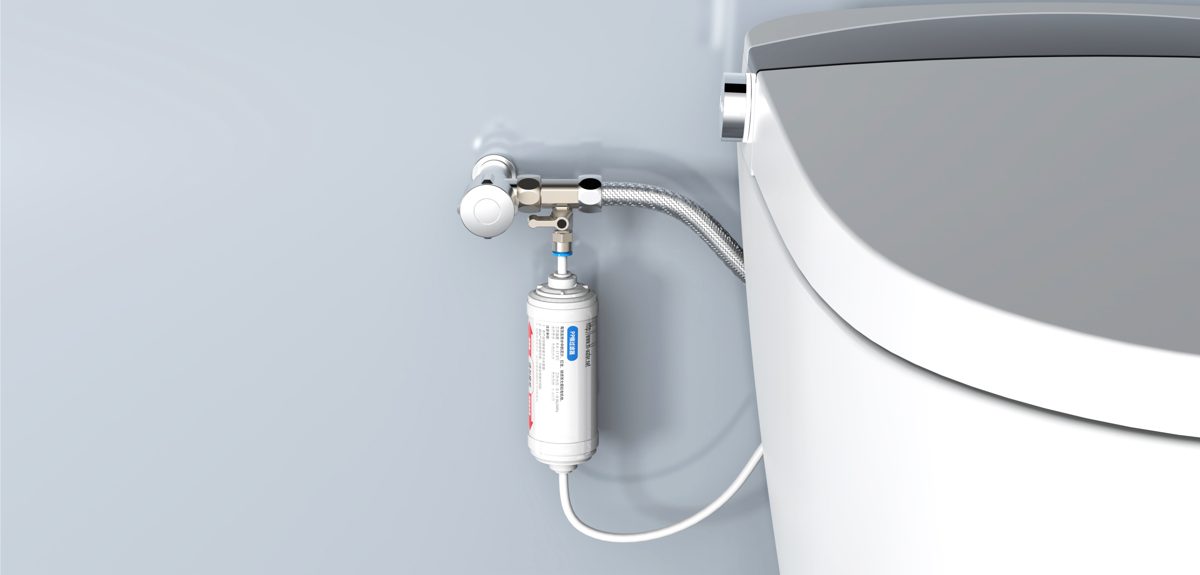
Bidet Filter Formats: Which One Fits Your Product?
Bathroom filters look alike in a catalogue but install very differently. Choose the format based on where the installer will put it, not on how it looks in the product photo. These are the formats in our bathroom filter range:
| Format | How it connects | Where it sits | Best for | Watch out for |
|---|---|---|---|---|
| Slim inline cartridge with push-fit ports (B / D series) | Push-fit tube on both ends | In the tube between a tee and the seat | Seat brands that already run a plastic tube to the seat | Tube OD must match the push-fit size exactly |
| Threaded inline filter (C / F series) | Male or female thread each end | Between the supply hose and the seat inlet | Retail replacement filters and aftermarket sales | Thread standard must match your market (see next section) |
| Elbow filter on the angle valve (E4) | Swivel nut straight onto the valve or tee outlet | Wall side, below the cistern | Tight spaces behind wall-hung and skirted toilets | Check clearance to the cistern and the wall |
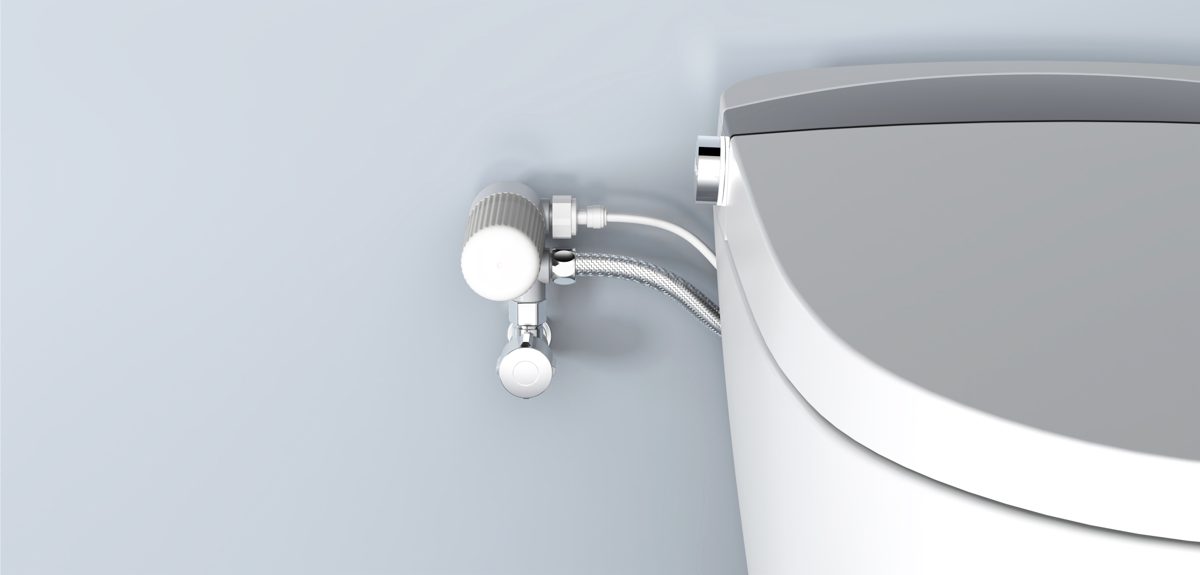
| Dual-outlet tee filter (E6) | One inlet, two outlets | Replaces the separate T-adapter | Filter installed at the same time as the seat | Only filters the seat branch if plumbed as designed; label both outlets |
The dual-outlet E6 tee filter is the one most brands overlook. A standard bidet installation needs a T-adapter anyway to split water between the cistern and the seat. If the filter is the tee, the installer handles one part instead of two, and your kit has one fewer leak point.
Looking for a reliable water filter manufacturer?
Get free samples and a factory-direct quote. MOQ from 500 pcs.
Get a Free Quote →Connection Standards by Market: The Thread Is the Spec
This is where most first orders go wrong. A factory’s standard filter is built for its home market, and “1/2-inch” means different things on different continents.
| Market | Typical supply connection at the toilet | What to specify for the filter |
|---|---|---|
| USA & Canada | 7/8-inch ballcock thread at the fill valve; bidet T-adapters split it to the seat | Either a filter with the matching thread on the seat hose side, or a filter built into a 7/8-inch tee |
| UK, EU, Middle East | 1/2-inch BSP (G1/2) or 3/8-inch BSP at the valve | G1/2 parallel thread with a flat washer seal |
| China, Southeast Asia | G1/2 angle valve, often with a separate tee | G1/2; the dual-outlet tee format works well here |
| Japan-brand seats (TOTO, INAX and similar) | Often proprietary hose connections | Custom end fitting or adapter; send us the hose before quoting |
Two practical rules from our line:
- Put the thread standard in the PO, not just the size. “1/2 inch” on a Chinese drawing means G1/2 (BSPP, parallel). A US installer may assume NPT (tapered). They share the same 14 threads per inch, so a mismatched pair can screw on halfway and then leak.
- Parallel threads seal on the washer, not the thread. Every G1/2 port needs a flat washer or O-ring in the kit. Missing washers are the most common cause of the “leaks at the joint” return in the table above.
If your kit ships to more than one market, the cheapest fix is usually a common filter body with two end-fitting options, not two different filters.
Specifications to Put in Your Purchase Order
Product pages say “PP filter, 6 months” and very little else. The table below lists our standard label values and what we recommend you fix in writing for a private-label order. For how each value is checked at inspection, see our cartridge quality inspection guide.
| Parameter | XZH standard (on label) | What to specify in your PO |
|---|---|---|
| Media | PP melt-blown (“precise PP filter”) | Media type plus nominal micron rating (5 µm or 10 µm) |
| Working pressure | 0.1-0.862 MPa (15-125 psi) | Minimum and maximum; ask for a hydrostatic test pressure on sealed units |
| Working temperature | 4.4-37.8 °C (40-100 °F) | State “cold water line only” on the label and in the manual |
| Water supply | Municipal tap water | Say whether well water is excluded; it changes the replacement interval |
| Replacement interval | 3-6 months | The interval printed on the box, and the assumption behind it (users, water quality) |
| Flow direction | Arrows: inlet tee to toilet seat | Arrows moulded or printed on the body and on the label; “Do not connect in reverse” warning |
| Connections | G1/2 thread or push-fit, by series | Thread standard, gender of each end, washer or O-ring material |
| Housing | Translucent PP or opaque ABS, by series | Material, colour, and whether the media must be visible |
| Packaging | Polybag + carton, custom retail box on OEM orders | Box size, barcode, language, installation diagram |
Two items on this list cause most disputes.
Flow direction. A PP melt-blown filter works either way on day one. But reversed flow washes captured sediment back into the seat on the next pressure surge, and on filters with a support core it can collapse the media. Our labels say “Connect the entrance tee” at one end, “Connect the intelligent toilet seat” at the other and “Do not connect it reversely” in the middle, because installers do not read manuals.
The replacement interval. “6 months” is a promise to your customer. Brondell’s SWF44 and BidetKing’s filters both print 6 months. Our own labels say 3-6 months, because a filter in an old building with rusty risers will not last six. If you print 6 months, print the conditions too.
Media Options and the Claims You Can Print
Sediment is the core job. Brands often want more on the box, so here are the realistic options and the claim risk for each.
| Media | What it actually does in a bidet filter | Claim you can safely make | Claim risk |
|---|---|---|---|
| PP melt-blown, 5-10 µm | Captures sand, rust, scale flakes, red worms | ”Reduces sediment, rust and particles; protects your seat” | Low |
| Granular activated carbon (GAC) | Reduces chlorine taste/odour; small volume, short contact time | ”Reduces chlorine odour” | Low, but capacity in a filter this size is small |
| Polyphosphate / scale inhibitor | Slows scale formation in the heater | ”Helps reduce scale build-up” | Low; see our scale inhibitor comparison for limits |
| ”Ion”, silver or antimicrobial media | Varies widely by supplier | Only with regulatory review in your market | High in the US |
The last row matters for Amazon and US retail. EPA’s device guidance says water filters that limit claims to taste, odour or sediment are generally not regulated under FIFRA. A filter claiming to kill or suppress bacteria is a pesticide device: it must be made in an EPA-registered establishment, carry that establishment number on the outer packaging and be declared on import with a Notice of Arrival. If a substance such as silver does the antimicrobial work, the product may need full pesticide registration. Several US bidet filter listings use words like “sterilizing”. If you copy that wording, you take on that risk.
Our advice for a first private-label run: sell a well-specified sediment filter, claim sediment and equipment protection, and add media only where you can back up the claim.
Need help matching a filter to your bidet seat? Send us your seat model or hose fitting and we will recommend a format and connection.
Standards Your Bidet Seat Buyer Will Ask About
The filter is an accessory, but it goes onto a product that has its own standards. Your importer or retail buyer will expect the filter to fit into that framework.
- ASME A112.4.2 / CSA B45.16 (Personal Hygiene Devices for Water Closets, current edition 2021). This is the North American standard for bidet seats and sprayers. It requires backflow prevention on devices connected to potable water. Where an atmospheric vacuum breaker is used without a marked critical level, its lowest point must sit at least 25 mm (1 inch) above the flood-level rim. The 2015 edition also set spray cycle tests (50,000 cycles front, 25,000 rear) and an automatic shut-off at 48 °C (118 °F). Practical point: your filter must not be installed downstream of the seat’s backflow device in a way that changes the certified configuration. Install it on the supply side, as our labels specify.
- UL 1431 / CSA C22.2 cover the seat’s electrical safety, not the filter. They still show up in buyer questionnaires, so know which part of the kit each standard applies to.
- GB/T 23131-2019 (household electrical toilets, China) is the standard seat makers here build to, and it is the one your Chinese seat supplier will quote.
For food-contact and drinking-water certifications on our other cartridges, see NSF 42 vs 53 vs 58 vs 401. A bidet sediment filter is not a drinking-water product, and it should not be marketed as one.
Market Size, Pricing and Why Filters Are a Repeat Business
In Japan, a Cabinet Office consumer survey found 80.2% of households with two or more people owned an electronic bidet toilet seat (March 2018). North America and Europe are far behind that level, which is why US bidet brands have grown quickly since 2020 and why seat makers in China are adding capacity.
For a brand, the filter economics are simple:
| Item | Figure | Source |
|---|---|---|
| Retail price, branded replacement bidet filter (US) | USD 24.99 single (Brondell SWF44) | Brondell website |
| Replacement interval | 6 months (brands) / 3-6 months (our label) | Brand pages / XZH label |
| Filters per seat per year | 2-4 | Calculated from the interval |
| FOB Ningbo, basic PP inline filter, 1,000 pcs | From about USD 0.60/pc | XZH bulk price guide; final price depends on format and fittings |
| MOQ / lead time | 500 pcs per SKU / 15-20 days | XZH |
A seat sells once. A filter sells two to four times a year for as long as the seat is in use. Brands that ship one filter in the box, print the replacement date on it and sell 3-packs on the same listing turn a one-off purchase into a subscription. When you model the programme, add freight and duty using our landed cost guide. The filter is light, but retail boxes take up a lot of carton space.
How We Run a Private-Label Bidet Filter Order
- Send us the seat, hose or fitting drawing. We confirm the format (inline, elbow or tee) and the thread standard before anything else.
- Samples in your chosen connection. Standard formats ship as samples; test them on the actual seat, at your market’s typical water pressure.
- Lock the spec sheet. Micron rating, pressure/temperature rating, flow arrows, washer material and the replacement interval printed on the box, following the PO table above.
- Artwork. Your logo, flow-direction arrows, “cold water only” warning and barcode. Check claims against the media table.
- Production and inspection. 15-20 days for standard formats. Every batch is checked for weight, dimensions, thread fit and leaks before packing. See our PP sediment cartridge guide for how melt-blown media is specified.
- Shipping. FOB Ningbo; filters combine well with other cartridges in a mixed container. Store them dry and sealed; see our shelf life and storage guide.
If you are building a filter brand from scratch rather than adding a filter to an existing seat, start with how to launch a private-label water filter brand. Our OEM manufacturing page covers moulds, packaging and certification support.
Related Guides
- PP Sediment Filter Cartridges: Specifications, Applications & OEM Sourcing
- Water Filter Cartridge Quality Inspection: AQL & On-Site Tests
- Quick-Connect vs Standard Housing Water Filters
- Scale Control Compared: Polyphosphate vs Softener vs RO
- How to Start a Private-Label Water Filter Brand
Request a Quote for Your Bidet Filter Programme
Tell us your seat model or supply connection, your target market and your expected annual volume. We will send a recommended format, a draft spec sheet and a quotation, with samples in your connection. MOQ 500 pcs per SKU, 15-20 day lead time, custom labels and retail packaging available.
Frequently Asked Questions
- Does a bidet seat really need a water filter?
- An electronic bidet seat does not need a filter to work on day one, but it needs one to keep working. The seat has a solenoid valve, a small flow regulator, a heater and spray nozzles with very small openings. Sand, pipe scale, rust flakes and red worms (midge larvae) from the supply line are the most common reason a seat drips into the bowl, loses spray pressure or shows a heater error in the first year. A 5-10 micron sediment filter on the inlet costs a fraction of a service call and is why most seat brands either ship one in the box or sell one as a replacement part.
- How often should a bidet seat filter be replaced?
- Our bathroom filters are labelled for 3 to 6 months on municipal tap water. Brondell's SWF44 and BidetKing's inline filters both use a 6-month interval. Use 3 months for older buildings, water with visible sediment or high use (four or more people, or a shared office washroom) and 6 months for newer plumbing and one or two users. A simple test: if the spray pressure has visibly dropped and recovers after the filter is removed, the filter is loaded and should be changed.
- What micron rating should a bidet filter have?
- Most bidet seat filters on the market are 5-10 micron sediment filters, and 10 micron is the most common figure quoted by seat brands. For a private-label programme we recommend 5 micron PP melt-blown where the water carries fine rust or sand, and 10 micron where flow is the priority and the water is clean. Do not go finer than 5 micron in a filter this small: the pressure drop rises and the filter clogs before the replacement date printed on your box.
- Can a bidet filter be installed on the hot water line?
- No, not the filters we make. Our bathroom filters are rated 4.4-37.8 °C (40-100 °F) and labelled for cold-water lines only, and competitor filters such as Brondell's SWF44 carry the same cold-water-only instruction. Electronic bidet seats heat water inside the seat, so the filter only ever needs to handle the cold supply. If your product is a non-electric bidet attachment with a hot-water feed, you need a different housing and O-ring specification, and you should ask for it explicitly.
- Will a universal bidet filter fit TOTO or INAX seats?
- Usually not directly. Most universal bidet filters have one male and one female 1/2-inch thread and fit seats that use a standard threaded supply hose. Japanese seats such as TOTO and INAX often use proprietary hose connections, so a universal filter needs an adapter or a custom end fitting. If your brand wants to sell a filter that fits a named seat, send us the seat's supply hose or its fitting drawing and we will quote a matching connection before tooling.
- Can I market a bidet filter as antibacterial?
- Be careful in the United States. EPA guidance says water filters that limit their claims to taste, odour or sediment are generally not pesticidal devices under FIFRA. Filters claiming to kill or suppress bacteria, viruses or fungi are regulated as pesticide devices: they must be produced in an EPA-registered establishment with the establishment number on the outer packaging, and imports require a Notice of Arrival (EPA Form 3540-1). If a filter uses a substance such as silver to do the antimicrobial job, it may need full pesticide registration. For a sediment bidet filter, claim sediment, rust and particle reduction and equipment protection.
- What is the MOQ and lead time for private-label bidet seat filters?
- Our MOQ is 500 pcs per SKU, with a standard lead time of 15-20 days after sample approval and deposit, shipped FOB Ningbo on T/T 30% deposit and 70% before shipment. Samples are available with shipping paid by the buyer. Custom labels, flow-direction printing and retail packaging are included in a normal OEM order; a new end fitting or housing shape needs a mould and adds time, so confirm the connection before you approve artwork.
Looking for OEM Water Filter Cartridges?
Get a factory-direct quote from Ningbo XZH — 15+ years OEM experience, 50+ export markets, MOQ from 500 pcs.
Get a Free Quote →Get Our Full Product Catalog
100+ SKUs with specs, MOQ, and factory-direct wholesale pricing — everything covered in this article and more.