
Blog ·
PFAS Water Filter Certification: What NSF 53 Proves | XZH
NSF/ANSI 53 PFAS claims decoded: 1,500 vs 2,160 ppt challenges, 70 vs 20 ppt pass limits, and why EPA's 4.0 ng/L MCL breaks both. MOQ 500 pcs, FOB Ningbo.
Short answer: “NSF/ANSI 53 certified for PFAS” is not one claim, it is two, and neither of them means the water meets the EPA limit. The older PFOA/PFOS claim challenges the filter with 1,500 ng/L and passes it at 70 ng/L in the treated water — a number inherited from EPA’s withdrawn 2016 health advisory. The newer Total PFAS claim covers seven compounds, challenges at 2,160 ng/L and passes at 20 ng/L. The enforceable MCL at 40 CFR 141.61(c)(2) is 4.0 ng/L for PFOA and for PFOS. So a currently certified filter can leave 17 times the MCL in the glass and the certification is still perfectly valid. And the claim is expensive in a second way nobody puts on the box: every certified point-of-use device on Pennsylvania’s August 2026 list is rated for 400 to 600 gallons, roughly a tenth of what the same carbon block is rated for on a chlorine claim.
We manufacture carbon block, GAC, PP sediment, UF and RO cartridges in Ningbo for importers and private-label brands in North America, Europe, Russia and the Middle East. PFAS is now the single most common question in our inbox from US buyers, and the most common thing we have to un-say. This guide is the internal version: the actual test numbers, the arithmetic between them, what a PFAS claim costs a factory, and the wording that keeps it out of your purchase order by accident.
What EPA Actually Regulates, as of September 2026
The 2024 PFAS National Primary Drinking Water Regulation is codified in two places: the MCLs sit at 40 CFR 141.61(c)(2) and the monitoring machinery sits in 40 CFR part 141, Subpart Z (§§ 141.900–141.905, source note 89 FR 32750, 26 April 2024).
| Contaminant | MCL | HBWC for Hazard Index | Monitoring trigger level |
|---|---|---|---|
| PFOA | 4.0 ng/L (0.0000040 mg/L) | not applicable | 2.0 ng/L |
| PFOS | 4.0 ng/L (0.0000040 mg/L) | not applicable | 2.0 ng/L |
| PFHxS | 10 ng/L | 10 ng/L | 5 ng/L |
| PFNA | 10 ng/L | 10 ng/L | 5 ng/L |
| HFPO-DA (GenX) | 10 ng/L | 10 ng/L | 5 ng/L |
| PFBS | no individual MCL | 2,000 ng/L | — |
| Hazard Index mixture | 1 (unitless) | — | 0.5 |
The Hazard Index is a sum of quotients, given verbatim in the regulation:
Hazard Index = ([HFPO-DA]/10) + ([PFBS]/2,000) + ([PFNA]/10) + ([PFHxS]/10), all in ng/L
Three dates matter, and they are the reason your customers are asking you about this now:
| Deadline | Requirement | Citation |
|---|---|---|
| 25 June 2024 | Systems must use EPA Method 533 or 537.1 v2.0; labs within 70–130% of true value on PE samples | § 141.901 |
| 26 April 2027 | Initial monitoring results reported to the state; compliance monitoring begins | § 141.900(b)(2)–(3) |
| 26 April 2029 | MCL compliance required; MCL violations may be assessed | § 141.900(b)(4), § 141.60(a)(4) |
The 2026 rollback has not happened yet
This is worth saying plainly because supplier literature is already getting it wrong. On 20 May 2026 EPA published two proposed rules:
- 91 FR 29413 — rescind the regulatory determinations and associated provisions for PFHxS, PFNA, HFPO-DA and the Hazard Index mixture, on the ground that determinations and regulations may not be finalised simultaneously.
- 91 FR 29425 — extend the PFOA and PFOS compliance deadline by two years, to 2031.
The comment period closed 20 July 2026. Neither is final. Until a final rule publishes, all six compounds and the Hazard Index remain in force at § 141.61(c)(2) with a 2029 compliance date, and EPA has separately said it intends to keep the PFOA and PFOS MCLs regardless. State MCLs are untouched by either proposal.
For a factory or a brand, the practical read is: the two numbers that will still be standing in 2031 are 4.0 ng/L PFOA and 4.0 ng/L PFOS. Design and specify against those, not against the headline that the rule was rolled back.
Two Different PFAS Claims Hide Behind One Standard Number
Here is the part that causes most of the commercial confusion. NSF/ANSI 53 (filtration devices) and NSF/ANSI 58 (reverse osmosis) each contain two separate PFAS reduction claims, added at different times, with different compound lists and different pass limits. A certificate that says only “NSF/ANSI 53” tells you nothing about which one a product holds.
| PFOA/PFOS claim (legacy, NSF P473 lineage, 2019–2021 editions) | Total PFAS claim (2022/2023 editions) | |
|---|---|---|
| Compounds | 2: PFOA, PFOS | 7: PFOA, PFOS, PFHxS, PFBS, PFNA, PFHpA, PFDA |
| Total influent challenge | 1,500 ng/L (PFOS 1,000 + PFOA 500) | 2,160 ng/L |
| Max permissible product water | 70 ng/L combined | 20 ng/L total |
| Per-compound effluent limits | not broken out | 20 ng/L for PFOA, PFOS, PFHxS, PFHpA; 6 ng/L for PFNA |
| Origin of the limit | EPA’s 2016 lifetime health advisory of 70 ppt (withdrawn) | Aligned to the newer MCL era, but not equal to it |
| Ratio to the 4.0 ng/L MCL | 17.5× | 5× |
The Total PFAS challenge mixture is worth reading compound by compound, because its composition is the whole reason carbon struggles with it:
| Compound | Influent challenge |
|---|---|
| PFOS | 1,000 ng/L |
| PFOA | 500 ng/L |
| PFHxS | 300 ng/L |
| PFBS | 260 ng/L |
| PFNA | 50 ng/L |
| PFHpA | 40 ng/L |
| PFDA | 10 ng/L |
| Total | 2,160 ng/L |
PFBS is a four-carbon compound. Short-chain PFAS adsorb onto activated carbon far more weakly than PFOS and PFOA do, and the committee put 260 ng/L of it into the mixture on purpose. That single line is why a media that comfortably passes the two-compound claim can fail the seven-compound one.
Test conditions are also tougher than most buyers assume. The NSF/ANSI 53 protocol runs to 200 percent of the manufacturer’s rated capacity, at an initial inlet pressure of 60 psi, on a 50/50 cycle (ten minutes on, ten minutes off) or a 10/90 alternative. The NSF/ANSI 58 version for RO uses test water at 750 ± 40 mg/L TDS and requires 99 percent reduction.
And the market has not moved to the new claim. Pennsylvania DEP’s list of certified point-of-use devices, last updated August 2026, opens by telling residents that “as of August 2026, filter certifications focus on removing the chemicals PFOA and PFOS.” The first Total PFAS certification in the world was only announced in December 2023. Three years on, the two-compound claim is still what is on the shelf.
Looking for a reliable water filter manufacturer?
Get free samples and a factory-direct quote. MOQ from 500 pcs.
Get a Free Quote →The Arithmetic Nobody in the Search Results Does
Consumer guides on this topic quote the 70 ppt figure as though it were the requirement, and stop. None of the pages ranking for PFAS filter certification put the 70 alongside the 4.0. So here is the worked example, using a real published performance data sheet rather than a hypothetical.
Take the Multipure Aquaperform (model MP880, replacement filter CB11As), a stainless-steel undersink carbon block certified to NSF/ANSI 42 and 53 and listed by a US state agency as PFAS-certified. Its published performance data sheet states, for the PFOA/PFOS row:
- Influent challenge: 0.0015 mg/L ± 10% — that is the 1,500 ng/L matrix
- Reduction demonstrated: >95.5%, tested at 200% of capacity
- Max permissible product water: 0.0001 mg/L as printed
Now do the multiplication the data sheet does not:
1,500 ng/L × (1 − 0.955) = 67.5 ng/L in the treated water
67.5 ÷ 4.0 = 16.9× the enforceable PFOA MCL
This is not a criticism of that product. It is a well-made, genuinely certified filter, and 95.5 percent reduction is real performance. The point is structural: the standard’s pass line and the regulation’s compliance line are seventeen times apart, so passing the first tells you almost nothing about the second. A filter tested at the Total PFAS limit of 20 ng/L is still five times over.
The reason the gap exists is ordinary standards lag. The 70 ng/L limit was pegged to a health advisory EPA issued in 2016 and withdrawn in 2022. The MCL arrived in 2024. Certifications issued under the 2021 edition remain valid listings; nothing forces a relisting. So in 2026 the phrase “NSF/ANSI 53 certified for PFOA/PFOS reduction” can legitimately describe a device qualified against a number that is a decade old.
This is the same trap we wrote about with chlorine capacity ratings: a rated performance figure is always measured under a specific challenge, and the field condition is frequently the harsher one. With chlorine it is because EPA allows 4.0 mg/L in the distribution system while NSF/ANSI 42 challenges at 2.0 mg/L. With PFAS it runs the other way — the challenge is much higher than most real tap water — but the pass line is the thing that is out of date, and that is worse, because it is the number your customer will read as a guarantee.
Sourcing a filtration line and unsure which claims your market actually requires? Send us your target market and your water test report. We will tell you which claims are specifiable, which are worth paying for, and which ones no factory can honestly give you. Talk to our engineering team →
The PFAS Claim Costs You About 90% of Your Rated Capacity
This is the finding that changes a distributor’s business model, and it comes straight out of the state device list rather than from any marketing page.
| Device (from PA DEP list, Aug 2026) | Type | Rated capacity | Replacement cost |
|---|---|---|---|
| A.O. Smith 2-stage carbon block | Undersink | 500 gallons | $83 / 6 months |
| Brondell Coral 3-stage | Undersink | 500 gallons | $80 / 6 months |
| Kohler Aquifer K-77685 | Undersink | 400 gallons | $83 / 5–6 months |
| Aquasana Claryum 3-stage | Undersink | 600 gallons | $84 / 6 months |
| Multipure Aquaperform MP880 | Undersink | 600 gallons | $150 / 6 months |
| Multipure Aqualuxe | Countertop | 500 gallons | $180 / 6 months |
| Amway eSpring e3 | Undersink | ~1,320 gallons | $254 / year |
Now compare that with what the same physical class of cartridge is rated for when it is sold on an aesthetic claim. A commodity extruded carbon block on a chlorine and taste-and-odour rating is routinely published at several thousand gallons — our own capacity guidance for a coconut-shell carbon block under a normal municipal chlorine load is in the 6,000-gallon range. Against the PFAS challenge, the same media gets rated at 500.
That is roughly a 12-fold reduction in rated life, and it is not a marketing decision. Three mechanisms stack:
- The test runs to 200% of the rating. Whatever capacity you claim, the lab pushes twice that volume through the cartridge and the effluent must still pass on the final sample. Claiming less capacity is the cheapest way to pass.
- Short-chain breakthrough arrives early. PFBS and PFHpA are weakly retained. Long before the carbon is exhausted for chlorine or for PFOS, the short-chain fraction starts appearing in the effluent.
- The pass line is in parts per trillion. Chlorine claims are judged in mg/L, PFAS claims in ng/L — six orders of magnitude apart. Analytically, there is nowhere to hide.
The commercial consequences are concrete, and they are what we actually discuss with private-label clients:
- Replacement revenue doubles or triples. Two changes a year instead of one, at a higher unit price. For a subscription brand that is upside; for a foodservice operator with a fixed PM schedule it is a cost surprise.
- Your landed cost per gallon of treated water goes up by an order of magnitude. Worth modelling before you price the SKU — see our cost comparison method and the landed-cost guide.
- You cannot put a PFAS claim on an existing long-life SKU. If your catalogue sells a 6,000-gallon cartridge and your new tender wants PFAS, that is a different product with different artwork, not a relabel.
- Any supplier quoting both numbers at once is guessing. A PFAS claim and a 6,000-gallon rating on one cartridge is the single clearest red flag in this category.
What a PFAS Claim Actually Requires From a Factory
Buyers routinely conflate two completely different kinds of paperwork. We spend more time explaining this distinction than any other in our documentation package.
| Material certification | Finished-product performance certification | |
|---|---|---|
| What it proves | The media and plastics are safe and structurally sound | This model, made in this plant, reduces this contaminant by this much |
| Typical standards | NSF/ANSI 42 or 53 material listings, NSF/ANSI 61 and 372, FDA food-contact | NSF/ANSI 53 or 58 named reduction claims |
| Who holds it | Media supplier, resin supplier, sometimes the cartridge plant | The brand owner, per model |
| Scope | The material, across customers | One model number, one facility |
| Cost and time | Included in normal supply; documents in days | USD 10,000–30,000 per program, 4–8 months |
| Can it support a PFAS label claim? | No | Yes, for exactly the claim named in the listing |
A few consequences that are easy to miss:
- Certification is per manufacturing facility. Moving the same tooling to a second plant voids the listing coverage until the new site is audited. This matters when a factory subcontracts a capacity overflow.
- Certification is per model. Changing the end cap, the wrap, the housing or the media lot specification can put you outside the listing.
- The certificate PDF is not the evidence. The evidence is the live entry in the certification body’s online listing — NSF, IAPMO or WQA. A certificate is a snapshot; a listing is current. Always verify the listing before shipment, and require the performance data sheet with the first article.
- Certified products are retested periodically and plants are audited annually. Certification is an ongoing cost, not a one-off fee.
For the broader documentation picture, our NSF 42 vs 53 vs 401 explainer and the certification guide covering NSF, FDA and SGS cover what sits in a normal OEM package.
A note on NSF/ANSI 401
NSF/ANSI 401 is repeatedly cited in supplier literature as PFAS evidence. It is not. The standard covers fifteen named emerging contaminants: atenolol, bisphenol A, carbamazepine, DEET, estrone, ibuprofen, linuron, meprobamate, metolachlor, naproxen, nonylphenol, phenytoin, TCEP, TCPP and trimethoprim. PFOA and PFOS are not among them. We had this wrong ourselves in an earlier article on micron ratings, where a table listed PFOA/PFOS under 401. It was incorrect and we have noted the correction here rather than quietly deleting it, because the same error is in a great many data sheets and it is worth being explicit about.
Our Own NSF Certificate, Read Honestly
The most useful thing we can show a buyer on this topic is our own paperwork, read the way a compliance officer would read it.
The NSF certificate in our documentation package states that NSF International recognises the facility as complying with NSF/ANSI 42 and all applicable requirements, that products appearing in the NSF official listing are authorised to bear the NSF mark, and that the certificate remains valid as long as the client has products in listing. It is dated 21 July 2016, certificate number C0262758-01, and it is issued in the name of an affiliated purification-technology entity in Zhejiang, not in our trading name.
Read carefully, that document says three things, and none of them is “PFAS”:
- It is Standard 42, not 53. Standard 42 is aesthetic effects — chlorine, taste and odour, particulate class. Health-effect claims, including every PFAS claim, live in 53 and 58.
- It points to a listing, not to a performance number. The certificate itself carries no contaminant, no challenge concentration and no capacity.
- It is ten years old and in another entity’s name. That is normal for a materials-level recognition in a supply chain, and it is exactly the kind of document that gets forwarded down a chain of three intermediaries until someone prints “NSF certified, removes PFAS” on a box.
Our 2026 catalogue reflects the same discipline. It claims 0.5-micron multi-fold filtration, reduction of sediment, rust, residual chlorine, VOCs and bacteria, and lead and VOC reduction from the functional media. Flow rates and capacities are published per model — for example 8 L/min and 125 m³ for the DSS/A/PA single system, 12 L/min and 195 m³ for the CHS/B/PA, both rated 0.172–0.862 MPa. There is no PFAS claim anywhere in it. That is a decision, not an omission. We would rather quote a media specification and third-party lot data than let a claim we cannot substantiate travel downstream on our letterhead.
What we can do, and do regularly:
- Supply carbon block, GAC and RO cartridges built to a media specification you or your consultant defines, including media selected for PFAS duty
- Provide third-party test data on the specific media lot, in weeks rather than months, at a small fraction of a certification program
- Build to the dimensional and connection standards your housing needs — see the thread standards guide
- Support a certification program you own, including the sample builds and the facility audit, if you decide the label claim is worth the budget
Which Technology Actually Removes PFAS
For completeness, since the media choice drives everything above. State health agencies consistently name three technology families for PFAS: granular activated carbon, reverse osmosis, and ion exchange resin.
| Technology | PFAS performance | Weakness | Our product line |
|---|---|---|---|
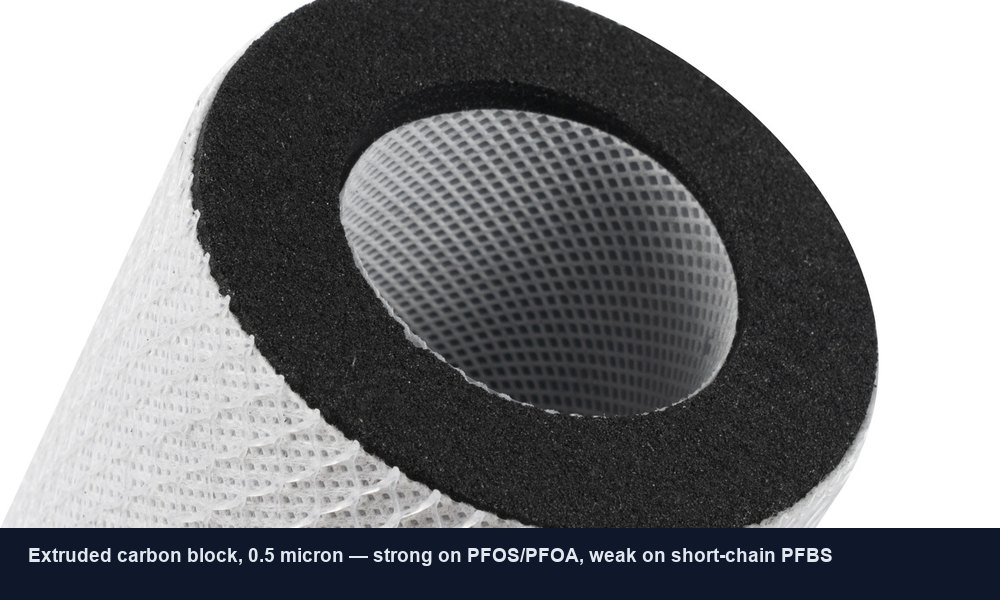
| Extruded carbon block | Good on long-chain (PFOS, PFOA); best carbon option because of contact time | Weak on short-chain (PFBS, PFBA, PFHxA); capacity collapses under PFAS duty | CTO carbon block |
| GAC | Moderate; strongly dependent on empty bed contact time | Channelling and early breakthrough; worse than block at the same volume | Coconut-shell activated carbon |
| RO membrane | Highest rejection across chain lengths, including short-chain | Permeate passes a post-carbon filter that must not re-release; wastewater; needs pressure | RO membrane cartridges, tankless RO systems |
| Ion exchange resin | High and selective with the right resin | Resin cost; regeneration and disposal; not a drop-in for a standard housing | DI mixed-bed cartridges |
| UF membrane | Essentially none — PFAS are dissolved, not particulate | Sold as “purification” and mistaken for PFAS treatment | UF cartridges |
That last row is worth its own sentence, because it is the most common technical error we see in tender documents: ultrafiltration does not remove PFAS. PFAS are dissolved molecules, and a 0.01-micron membrane is not a barrier to them. If a specification asks for PFAS reduction and names UF, the specification is internally inconsistent and needs to be raised before quotation, not after delivery.
How to Write PFAS Into a Purchase Order
The wording table we actually use in quotation review.
| What buyers write | What it gets you | What to write instead |
|---|---|---|
| ”PFAS certified” | Nothing specifiable. Any of: a material certificate, a lab report on a different model, or silence | ”Reduction claim to NSF/ANSI 53 Total PFAS, listing held by [brand] for model [number]" |
| "NSF certified” | Most likely an NSF/ANSI 42 material or facility recognition | Name the standard and the claim: “NSF/ANSI 53, lead and Total PFAS reduction claims" |
| "Removes 99% of PFAS” | A number with no challenge concentration behind it, therefore unverifiable | ”≥99% reduction from an influent of 2,160 ng/L total PFAS per NSF/ANSI 58 challenge matrix" |
| "NSF 401 certified for PFAS” | A certification that does not include PFOA or PFOS | Delete. 401 is the fifteen emerging contaminants; PFAS is 53/58 |
| ”6,000 gallon PFAS cartridge” | An impossible product; someone has merged two data sheets | Separate the claims: state the PFAS-rated capacity (expect 400–600 gal) and the chlorine-rated capacity separately |
| No mention of edition | A 2021-edition listing with a 70 ng/L pass limit | ”Certified to the 2022 edition or later, Total PFAS claim, 20 ng/L maximum product water” |
| No verification step | A PDF certificate, possibly expired or in another entity’s name | ”Listing to be verified in the certification body’s online database within 5 days of shipment” |
If your requirement is really risk reduction rather than label claim — which is true for most foodservice and commercial accounts — say so, and the conversation gets much cheaper. Third-party test data on a defined media, plus an honest capacity rating for your actual influent, delivers the outcome without a certification program. Start from your water analysis: our water test report to filter spec guide walks through turning a lab report into a media and capacity specification.
Where This Model Is Not Accurate
Every number above has a boundary, and a supplier who does not tell you where it is has not thought about it.
- The 17× figure is arithmetic on one product’s published sheet, not a survey. A device demonstrating 99.9% reduction from the same 1,500 ng/L challenge leaves 1.5 ng/L, which is inside the MCL. The structural point stands — the pass line is 70, so certification does not guarantee compliance — but individual products vary widely, and some certified filters genuinely hit the MCL. Read the actual reduction percentage, not just the claim.
- The challenge matrix is not your water. 2,160 ng/L total PFAS is far above most contaminated municipal supplies and far below some industrial plumes. A site with 8,000 ng/L of a single short-chain compound is outside the test envelope entirely, and no certification speaks to it.
- Rated capacity derating is not linear. Breakthrough is a curve, and it is a different curve per compound. Halving the influent does not double the useful life, and a cartridge can be simultaneously fine for PFOS and failing for PFBS.
- RO is not a complete answer by itself. The membrane rejects PFAS well, but the permeate passes a post-carbon filter, and the storage and post-treatment train has to be qualified too. NSF/ANSI 58 tests the system, not the membrane.
- We do not hold a finished-product PFAS listing. Everything we can tell you about achievable performance comes from media-supplier data and third-party lot testing, not from our own certified claim. Treat it as engineering input, not as a substitute for a listing.
- Regulation is moving. Two proposed federal rules are pending and states are legislating independently. Any specification written today should name an edition and a date, and be revisited before the 2029 compliance milestone.
Summary
- The enforceable US limits are 4.0 ng/L for PFOA and 4.0 ng/L for PFOS, codified at 40 CFR 141.61(c)(2), MCL compliance due 26 April 2029. The May 2026 rescission and extension rules are proposals, not law.
- “NSF/ANSI 53 for PFAS” is two claims. The legacy PFOA/PFOS claim passes at 70 ng/L from a 1,500 ng/L challenge; the Total PFAS claim passes at 20 ng/L from a 2,160 ng/L challenge across seven compounds. Neither equals the MCL.
- A validly certified filter can leave ~17× the MCL in the treated water. Read the reduction percentage, not the badge.
- The claim costs about 90% of rated capacity: certified point-of-use devices are rated 400–600 gallons, against several thousand for the same carbon block on a chlorine claim. Any supplier offering both numbers on one cartridge is wrong.
- Material certification is not performance certification. A finished-product NSF/ANSI 53 claim runs USD 10,000–30,000 and 4–8 months, per model and per facility. Verify the online listing, not the PDF.
- NSF/ANSI 401 does not cover PFAS. Nor does ultrafiltration.
Need a filtration line specified against a real contaminant list rather than a badge? Send us your water test report and your target market. We will return a media specification, a realistic rated capacity for your influent, and an honest list of the documentation we can supply for it. MOQ 500 pcs per SKU, 15–20 days after sample approval, FOB Ningbo, T/T 30/70. Request a quote for your PFAS-duty cartridges →
Related Guides
- NSF 42 vs 53 vs 401: what each certification actually covers
- Water filter certification guide: NSF, FDA and SGS documentation
- Turning a water test report into a filter specification
- Micron ratings explained: 0.5 vs 1 vs 5 vs 10 micron
- How to start a private-label water filter brand
- OEM water filter sourcing: importer due diligence
- OEM manufacturing capability and documentation package
Primary sources. 40 CFR 141.61(c)(2) and 40 CFR part 141 Subpart Z §§ 141.900–141.905 (eCFR current text; source note 89 FR 32750, 26 April 2024); 40 CFR 141.60(a)(4) effective date; 91 FR 29413 and 91 FR 29425, both Proposed Rules published 20 May 2026, comments closed 20 July 2026 (Federal Register); NSF/ANSI 53 and 58 PFAS claim parameters as published in Water Conditioning & Purification (Nov 2016, May 2023, Jun 2023, Nov 2025); Multipure Aquaperform MP880 NSF performance data sheet; Pennsylvania DEP, Point of Use Units that are ANSI/NSF 53 Certified for the Removal of PFOA and PFOS, last updated August 2026; NSF/ANSI 401 contaminant list per NSF listing categories; Ningbo XZH 2026 product catalogue and NSF certificate C0262758-01 (21 July 2016).
Frequently Asked Questions
- Does NSF/ANSI 53 certification mean a filter removes PFAS to the EPA limit?
- No, and the gap is large. The long-standing NSF/ANSI 53 PFOA/PFOS claim challenges the filter with 1,500 ng/L (1,000 ng/L PFOS plus 500 ng/L PFOA) and passes it if the product water stays at or below 70 ng/L combined. That 70 ng/L came from EPA's 2016 lifetime health advisory, which no longer exists. The enforceable MCL codified at 40 CFR 141.61(c)(2) is 4.0 ng/L each for PFOA and PFOS. A filter can therefore hold a current, valid NSF/ANSI 53 PFOA/PFOS certification while leaving roughly 17 times the MCL in the treated water. The newer Total PFAS claim tightens the limit to 20 ng/L across seven compounds, which is still five times the MCL. Certification proves the claim on the label was verified; it does not prove compliance with a drinking-water standard.
- What is the difference between the PFOA/PFOS claim and the Total PFAS claim under NSF/ANSI 53?
- They are two different claims sharing one standard number, and a certificate that only says 'NSF/ANSI 53' does not tell you which one you have. The PFOA/PFOS claim covers two compounds, challenges at 1,500 ng/L total and passes at 70 ng/L. The Total PFAS claim, added in the 2022/2023 editions of NSF/ANSI 53 and 58, covers seven compounds (PFOA, PFOS, PFHxS, PFBS, PFNA, PFHpA, PFDA), challenges at 2,160 ng/L total and passes at 20 ng/L total. Ask for the certification body's online listing entry, not the PDF certificate, and read which reduction claims are named. Pennsylvania DEP's own device list, last updated August 2026, still states that filter certifications focus on PFOA and PFOS, so in practice most listed products carry the two-compound claim.
- Why do PFAS-certified filters have such short rated capacity?
- Because the test runs to 200 percent of the manufacturer's rated capacity and PFAS breaks through carbon long before chlorine does. A normal carbon block sold on a chlorine reduction claim under NSF/ANSI 42 is commonly rated for several thousand gallons. Every certified point-of-use device on Pennsylvania DEP's August 2026 list is rated between 400 and 600 gallons, with one outlier at about 1,320 gallons. Short-chain compounds are the reason: PFBS and PFHpA adsorb poorly onto activated carbon, and the Total PFAS challenge deliberately includes 260 ng/L of PFBS. If a supplier offers you a PFAS claim and a 6,000-gallon rating on the same cartridge, one of the two numbers is wrong.
- Can a Chinese OEM factory supply PFAS-certified water filter cartridges?
- A factory can supply cartridges built from media that a certified device uses, and it can supply test data. What it usually cannot supply, and what buyers most often assume is included, is a finished-product listing in your brand name. NSF/ANSI 53 health-claim certification is per model and per manufacturing facility, costs roughly USD 10,000 to 30,000 per program and takes four to eight months. Our own factory holds ISO 9001:2015, food-contact documentation and NSF-certified raw materials, and our 2026 catalogue carries no PFAS claim. That is deliberate. If your tender requires a PFAS listing, budget the certification program separately and start it before you commit to artwork.
- Is NSF/ANSI 401 a PFAS certification?
- No. NSF/ANSI 401 covers fifteen named emerging contaminants: atenolol, bisphenol A, carbamazepine, DEET, estrone, ibuprofen, linuron, meprobamate, metolachlor, naproxen, nonylphenol, phenytoin, TCEP, TCPP and trimethoprim. PFOA and PFOS are not on that list. PFAS reduction claims live in NSF/ANSI 53 for filtration devices and NSF/ANSI 58 for reverse osmosis systems. This is a common error in supplier literature, including in one of our own older articles, which we have corrected. If a data sheet cites 401 as evidence of PFAS performance, the data sheet is wrong.
- Did EPA cancel the PFAS drinking water rule in 2026?
- Not as of this writing. EPA published two proposed rules on 20 May 2026: 91 FR 29413, which would rescind the regulatory determinations and provisions for PFHxS, PFNA, HFPO-DA (GenX) and the Hazard Index mixture, and 91 FR 29425, which would let systems request two extra years, to 2031, for PFOA and PFOS. The comment period closed 20 July 2026 and neither has been finalised. Until a final rule publishes, all six compounds plus the Hazard Index remain codified at 40 CFR 141.61(c)(2) with MCL compliance due 26 April 2029. EPA has also said it intends to keep the PFOA and PFOS MCLs, and state-level limits are unaffected either way. Planning a product line on the assumption that the rollback already happened is a commercial risk, not a saving.
- What should I write into a purchase order if I need PFAS performance?
- Name the standard, the edition, the claim and the holder. 'PFAS certified' is not specifiable. Write, for example: reduction claim to NSF/ANSI 53 Total PFAS, certification held by [brand] for model [number], listing to be verified in the certification body's online database before shipment, with the performance data sheet attached to the first article. Add the rated capacity and the influent concentration the rating assumes, because a 600-gallon rating and a 6,000-gallon rating are different products. If you only need PFAS reduction evidence rather than a label claim, ask for third-party test data on the specific media lot instead, which is far cheaper and available in weeks.
- What are the MOQ, lead time and commercial terms for OEM filter cartridges?
- Our MOQ is 500 pcs per SKU for cartridges, heads and housings, with 15 to 20 days lead time after sample approval and deposit, FOB Ningbo, T/T 30 percent deposit and 70 percent before shipment. Samples are built to the media, micron rating and connection you specify. Send us your water test report and the contaminant list your market regulates and we will return a media specification, a realistic rated capacity for that influent, and the documentation package we can actually supply for it.
Looking for OEM Water Filter Cartridges?
Get a factory-direct quote from Ningbo XZH — 15+ years OEM experience, 50+ export markets, MOQ from 500 pcs.
Get a Free Quote →Get Our Full Product Catalog
100+ SKUs with specs, MOQ, and factory-direct wholesale pricing — everything covered in this article and more.