
Blog ·
Water Filter Thread Sizes: NPT vs BSP vs Quick-Connect | XZH
NPT vs BSP (G, R, Rc) vs push-fit: thread charts in mm, why 1/2-inch threads engage but leak, 1/4-inch vs 6 mm tube traps, PO wording. MOQ 500 pcs. Free sample.
Short answer: Water filter connections come in three families. NPT (ASME B1.20.1, tapered, 60°) is the North American standard. BSP (ISO 228-1 parallel “G” and ISO 7-1 tapered “R/Rc”, 55°) is used almost everywhere else, including by Chinese factories by default. Push-fit quick-connect fittings are sized by tube outside diameter, not by thread. Most “leaking filter” complaints we investigate come from a mismatch between these families, not from the filter itself. At 1/2 and 3/4 inch, NPT and BSP threads screw together and still leak. A 1/4-inch tube is 6.35 mm, not 6 mm.
We manufacture quick-connect cartridges, filter heads and 10- and 20-inch housings in Ningbo for importers in North America, Europe, Russia, the Middle East and Southeast Asia. Every market wants a different connection, so we ship the same cartridge with several port options. This guide shows what we check before a connection goes into a purchase order, with dimensions in millimetres and the standard numbers your engineer and your inspector can work from.
Why the Connection, Not the Filter, Causes Most Leak Returns
When a distributor sends us a “leaking filter” claim, we ask for photos of the joint before anything else. The failure usually falls into one of four patterns:
| What the customer reports | What actually happened | Root cause |
|---|---|---|
| Slow weep at the port, gets worse over weeks | NPT male fitting installed into a G (BSPP) port, or the reverse | Thread standard not written on the PO |
| Port cracked a few days after installation | Tapered male thread plus PTFE tape over-tightened into a plastic female port | Installation instruction, not a moulding defect |
| Tube pops out of the quick-connect under pressure | Metric 6 mm tube in a 1/4-inch collet, or tube not fully inserted | Tube OD not specified |
| Leak at a parallel-thread joint | Washer missing, or PTFE tape used instead of a washer | Kit contents not specified |
None of these show up in a standard pre-shipment inspection, because the inspector tests the filter, not the joint between your plumbing and our port. That is why the connection has to be defined on paper before production starts. Our quality inspection and AQL guide covers the filter side. This article covers the connection side.
Water Filter Connection Types at a Glance
| Family | Standard | Designation on drawings | Form | How it seals | Main markets |
|---|---|---|---|---|---|
| NPT (tapered) | ASME B1.20.1 | 1/2”-14 NPT | 60°, taper 1:16 on diameter | On the thread flanks, with PTFE tape or sealant | USA, Canada, parts of Latin America |
| BSPP / G (parallel) | ISO 228-1 (China GB/T 7307, Russia GOST 6357) | G1/2 | 55°, straight | Not on the thread, but on a flat washer, O-ring or face seal | EU, UK, Russia/CIS, Middle East, Australia, China |
| BSPT / R, Rc, Rp (sealing on the thread) | ISO 7-1 / EN 10226-1 (China GB/T 7306) | R1/2 (male taper), Rc1/2 (female taper), Rp1/2 (female parallel) | 55°, taper 1:16 | On the thread flanks, with sealant | Metal plumbing in the same BSP markets |
| Push-fit quick-connect | Maker’s own specification. No single thread standard. | 1/4” OD tube, 3/8” OD tube, 6 mm, 8 mm | Collet grips the tube, O-ring seals it | O-ring on the tube’s outside diameter | Under-sink, RO, inline and appliance filters worldwide |
| Compression | Maker’s own specification | 1/4” OD compression | Nut + ferrule on tube | Ferrule deformation | Older US installations, ice machines |
One point causes most of the confusion: “BSP” is two different things. A G thread is parallel and needs a washer. An R thread is tapered and seals on the thread. On plastic filter heads and housings, almost everything is G. Tapered R threads mostly appear on brass adapters and metal pipework.
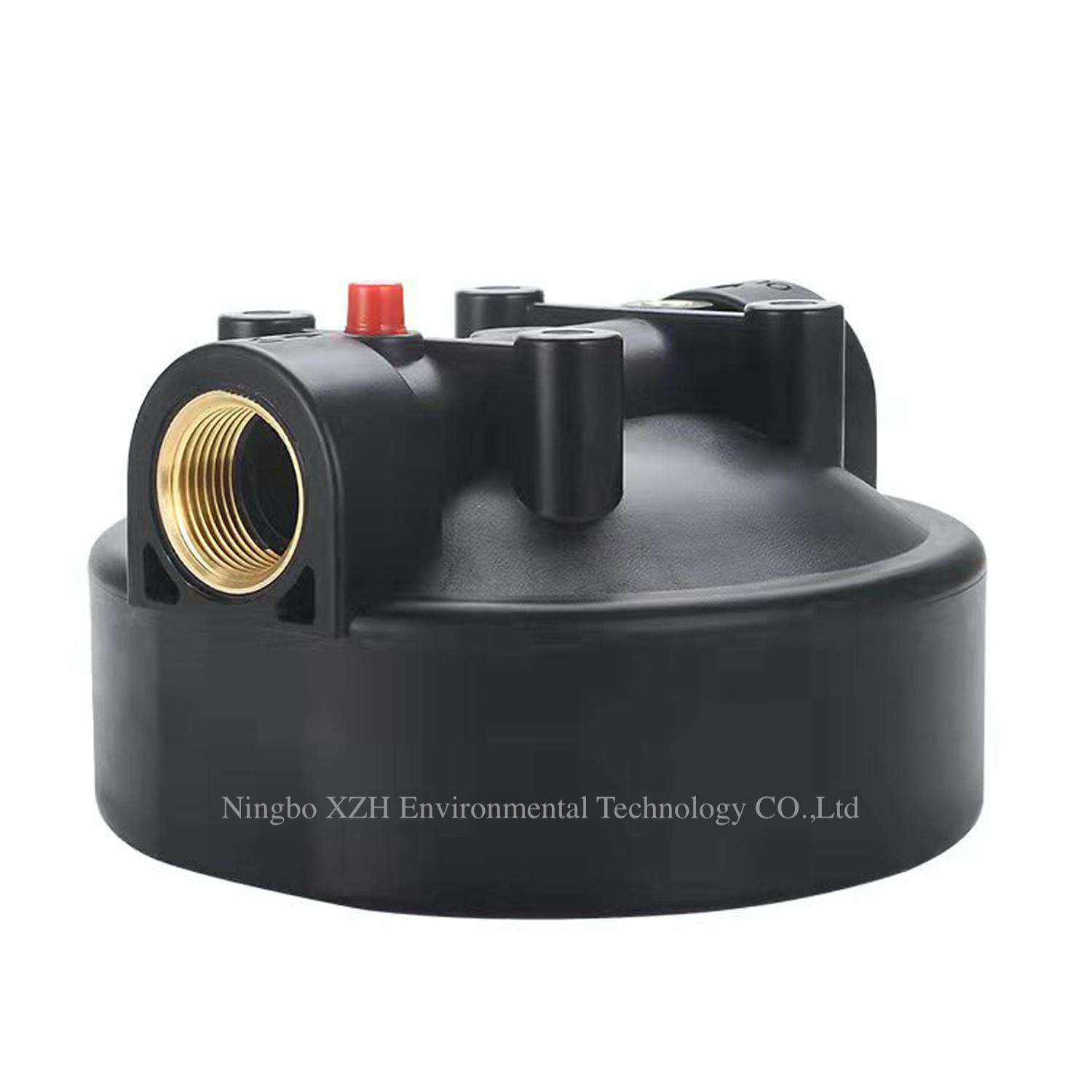
Our 20-inch big blue housing cap with a moulded-in brass port. The catalogue specifies these whole-house heads as G1 internal thread. The US version of the same cap needs a 1-inch NPT insert, and that has to be stated on the PO.
Looking for a reliable water filter manufacturer?
Get free samples and a factory-direct quote. MOQ from 500 pcs.
Get a Free Quote →NPT vs BSP Thread Chart in Millimetres
Retail charts usually list inch dimensions only. Chinese factory drawings and inspection reports use millimetres, so here are both standards side by side at the sizes used on water filters:
| Nominal size | NPT threads/inch | NPT pitch (mm) | NPT male OD (mm) | BSP threads/inch | BSP pitch (mm) | BSP major Ø (mm) | Screw together? |
|---|---|---|---|---|---|---|---|
| 1/8” | 27 | 0.941 | 10.29 | 28 | 0.907 | 9.73 | Cross-threads within about 2 turns |
| 1/4” | 18 | 1.411 | 13.72 | 19 | 1.337 | 13.16 | Cross-threads within 2-3 turns |
| 3/8” | 18 | 1.411 | 17.15 | 19 | 1.337 | 16.66 | Cross-threads within 2-3 turns |
| 1/2” | 14 | 1.814 | 21.34 | 14 | 1.814 | 20.96 | Yes, and leaks |
| 3/4” | 14 | 1.814 | 26.67 | 14 | 1.814 | 26.44 | Yes, and leaks |
| 1” | 11.5 | 2.209 | 33.40 | 11 | 2.309 | 33.25 | Binds after a few turns |
NPT outside diameters per ASME B1.20.1. BSP major diameters per ISO 228-1 / ISO 7-1. Pitch = 25.4 ÷ threads per inch.
The 1/2-inch and 3/4-inch trap
The two most common sizes on filter heads and whole-house housings are also the two where the standards share a pitch. A 1/2” NPT male fitting will turn into a G1/2 port by hand, and the joint feels normal. But the thread angles differ (60° vs 55°) and the diameters differ by about 0.4 mm. The flanks touch only along a line instead of across the face. At 20 psi in the warehouse the joint may hold. At 80-125 psi, with daily pressure cycling in a restaurant, it weeps within weeks.
Retail articles often say that 1/2” and 3/4” NPT and BSP “can be used together”. For a plastic port that has to hold mains pressure for 12 months, we would not accept that. Order the native thread, or use a rated G-to-NPT adapter.
Which Market Uses Which Connection
This is the table we work through with a new importer before we quote heads or housings:
| Destination market | Threaded ports on heads and housings | Quick-connect tube | What to watch |
|---|---|---|---|
| USA & Canada | NPT female (1/4”, 3/8” on foodservice heads, 3/4” and 1” on whole-house) | 1/4” and 3/8” OD | A US installer assumes “1/2 inch” means NPT. Foodservice heads such as the Everpure QL3 use 3/8” NPT female. |
| UK & EU | G (BSPP) with flat washer. G1/2, G3/4, G1. | Mostly 1/4” and 3/8” OD, some 6 mm and 8 mm | Parallel ports need washers in the kit. Some EU appliance makers use metric tube. |
| Russia & CIS | G per GOST 6357 (equivalent to ISO 228-1) | 1/4” OD dominant on under-sink systems | Retail systems (Aquaphor type) use their own twist-lock cartridges, so connection problems appear on the system side. |
| Middle East & GCC | G (BSP), inherited from British plumbing practice | 1/4” OD | Hot rooftop tanks can supply water above 38 °C, which is beyond many plastic housings’ ratings. |
| Australia & NZ | G (BSP) | 1/4” and 3/8” OD | Plumbing product certification (WaterMark) may apply, so check before import. |
| Southeast Asia | Mostly G (BSP). Some NPT on imported US-brand systems. | 1/4” OD | Confirm with a photo of the local tap adapter. |
| Latin America | Mixed: NPT is common in Mexico, while BSP and ISO 7 are widely used in South America | 1/4” OD | Never assume. Ask for a photo of the fitting. |
If you sell one SKU into two of these markets, plan for two port variants of the same product, not one “universal” port. The cartridge inside does not change, so the extra cost sits mainly in the insert or fitting and in keeping stock of two variants.
Push-Fit Quick-Connect: The Size Is the Tube, Not the Thread
Quick-connect fittings cause a separate kind of confusion. “1/4-inch quick connect” can mean two different parts:
- A fitting that accepts 1/4-inch OD tube (6.35 mm), or
- A fitting with a 1/4-inch male NPT or BSP thread on one end, and a push-fit socket on the other that may take 1/4” or 3/8” tube.
Retail listings mix these all the time. A typical adapter title reads “3/8 female to 1/4 OD”. On a purchase order, write out both ends.
| Tube size called | Actual tube OD | Nearest metric tube | Difference | What goes wrong when mixed |
|---|---|---|---|---|
| 1/4” | 6.35 mm | 6 mm | 0.35 mm | Metric tube in an inch collet: weak grip, can blow out. Inch tube in a metric collet: forced fit, O-ring damage. |
| 5/16” | 7.94 mm | 8 mm | 0.06 mm | Often works, but not guaranteed. Test before production. |
| 3/8” | 9.53 mm | 10 mm | 0.47 mm | Metric 10 mm tube will not enter a 3/8” collet. 3/8” tube in a 10 mm collet is loose. |
| 1/2” | 12.70 mm | 12 mm | 0.70 mm | Not interchangeable. |
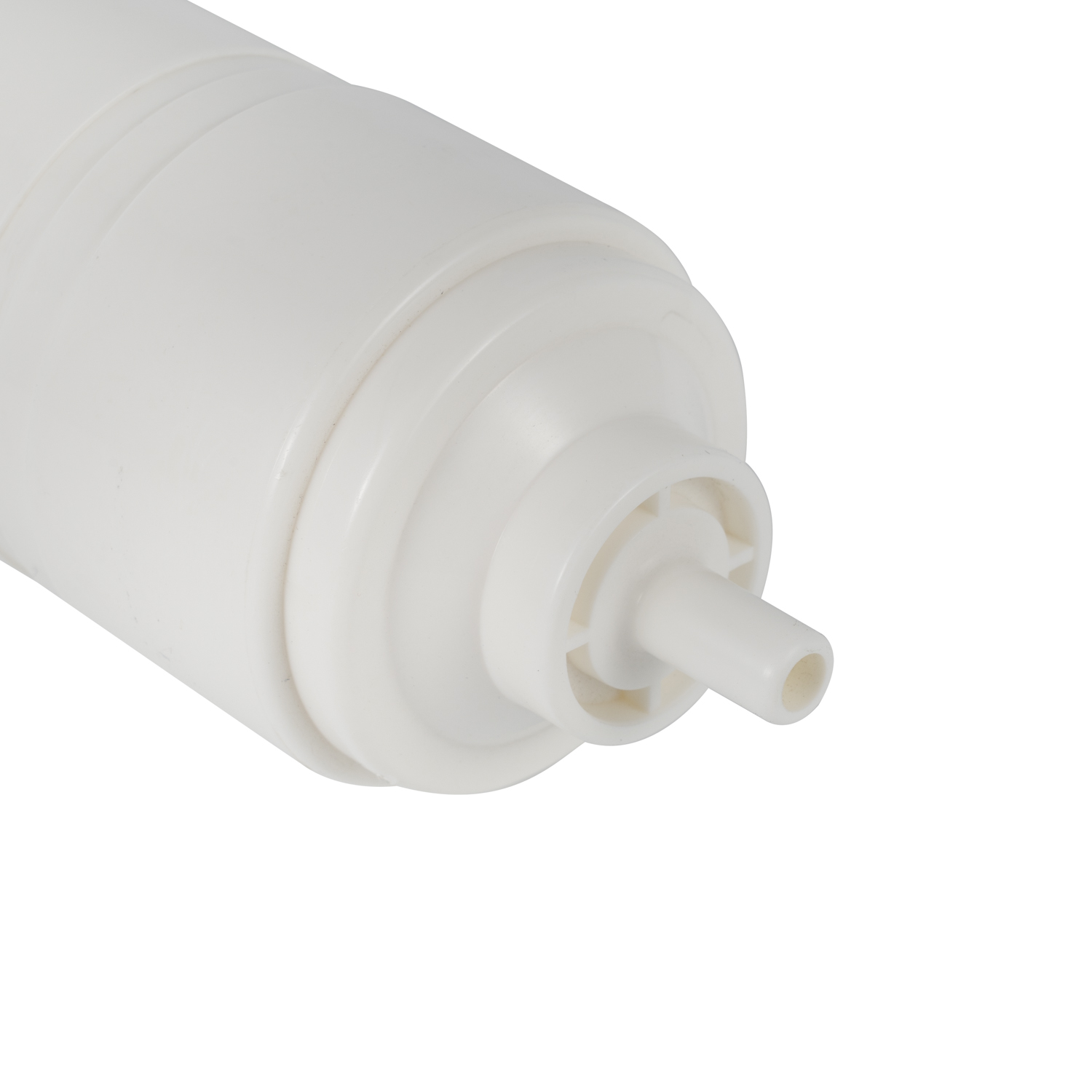
The outlet end of one of our I-type inline quick-connect cartridges. The stem outside diameter and O-ring groove are matched to a specific head or fitting. That is why compatible cartridges are specified by head model, not by “fits all”.
Three installation points we print on instruction sheets for private-label customers:
- Cut the tube square with a tube cutter, not a knife. An angled cut lifts one side of the O-ring.
- Push past the collet into the O-ring, then pull back to check the grip. A tube that stops at the collet feels seated but is not sealed. Mark the insertion depth on the tube.
- Use a tube insert (stiffener) with soft tubing. Without one, the tube can oval under the collet and leak at low pressure.
For drop-in quick-change cartridges that twist or push into a head, see our inline quick-connect cartridge guide and the step-by-step quick-connect filter replacement guide.
How Each Joint Seals, and What Not to Do
| Joint type | Correct seal | PTFE tape? | Tightening | Typical mistake |
|---|---|---|---|---|
| NPT or R male into a port | Thread interference + sealant | Yes, 2-3 wraps in the tightening direction | Hand-tight + about 1-1.5 turns on plastic ports | Over-tightening splits the plastic female port (a hoop-stress crack) |
| G parallel male into a G port | Flat washer or O-ring against the face | No, because tape cannot seal a parallel thread | Firm on the washer, no more | Washer left out, and tape used to “fix” the leak |
| Sump bowl onto cap (10” / 20” housing) | Large O-ring in the cap groove | Never | Hand-tight, then a quarter turn with the housing wrench | Tape or grease on the bowl thread. A dry or twisted O-ring. |
| Push-fit tube | O-ring on the tube OD | Not applicable | Full insertion depth | Tube not past the O-ring. Metric vs inch tube. |
| Compression | Ferrule | No | Per maker’s turns past hand-tight | Re-using a deformed ferrule |
On plastic heads and housings, one rule matters more than any other: a tapered male thread is a wedge. Every extra quarter turn raises the hoop stress in the female port. Brass inserts moulded into the port, as in the cap shown above, resist this much better than an all-plastic port. That is one reason we recommend brass inserts on whole-house housings at 3/4” and 1”.
What Our Catalogue Actually Specifies
For reference, these are the connection and rating lines from our own system catalogue. They show what a factory data sheet should state:
| System type | Rated flow | Rated capacity | Connection as catalogued | Working pressure | Water temperature |
|---|---|---|---|---|---|
| Single-head point-of-use (coffee, ice, tea equipment) | 8-12 L/min | 125-130 m³ | 3/8” quick-connect or G1/2 external thread | 0.172-0.862 MPa (25-125 psi) | 5-38 °C |
| Whole-house / commercial single and double heads | 30 L/min | 195-400 m³ | G1 internal thread | 0.172-0.862 MPa (25-125 psi) | 5-38 °C |
Two things to notice. First, every threaded port is catalogued as G, which is the default for a Ningbo factory. A US order has to state NPT explicitly. Second, the pressure rating covers the connection as well as the filter. Every sealed cartridge on our line is pressure-tested before packing, and our inspection specification for sealed cartridges is a 0.8 MPa (116 psi) hydrostatic hold for 5 minutes with no leak and no gauge drop. A different fitting from the installer’s toolbox is not covered by that test.
If you need the commercial heads for a North American foodservice programme, see our commercial filter systems and Everpure-compatible cartridges. For cross-referencing head and cartridge models, use the Everpure cross-reference chart.
How to Write the Connection on a Purchase Order
Most connection problems can be prevented at the PO stage. Replace the left column with the right column:
| Vague PO wording | What the factory will probably ship | Precise PO wording |
|---|---|---|
| ”1/2 inch thread” | G1/2 parallel (GB/T 7307) | “1/2”-14 NPT female per ASME B1.20.1, brass insert” or “G1/2 male per ISO 228-1, EPDM flat washer included" |
| "1/4 quick connect” | Whatever fitting is in stock | ”Push-fit for 1/4” (6.35 mm) OD PE tube both ends, EPDM O-ring, tube stiffener included" |
| "Standard housing” | 10” × 2.5” housing with G ports | ”10” × 2.5” housing, 3/4” NPT female inlet/outlet, pressure release button, bracket and wrench" |
| "Compatible with Everpure” | Cartridge only | ”Cartridge compatible with QL3-type head. Head, if supplied: 3/8” NPT female ports." |
| "Leak tested” | Visual check | ”Hydrostatic test 0.8 MPa, hold 5 min, 100% of sealed units, records in shipment folder" |
| "Fittings included” | Loose, mixed fittings | ”Kit: 2 × G1/2 washers, 1 × O-ring spare, instruction sheet showing tape/no-tape per joint” |
Attach a dimensioned drawing or, at minimum, a photo of your market’s mating fitting next to a ruler. It costs nothing and removes most of the risk. Our OEM sourcing guide for importers explains how the rest of the specification sheet fits together.
Identifying an Unknown Thread in 60 Seconds
When a customer sends a competitor’s housing to copy, this is how our engineers identify the thread:
- Measure the major diameter of the male thread with a caliper (or the minor diameter of the female thread). Compare with the chart above.
- Measure the pitch with a pitch gauge. 1.411 mm (18 TPI) means NPT at 1/4” or 3/8”. 1.337 mm (19 TPI) means BSP at the same sizes.
- At 1/2” and 3/4”, check the thread angle with a 55° or 60° gauge. The pitch will not tell you, because it is 1.814 mm in both standards.
- Check for taper. Lay a straight edge along the crests. If the gap grows towards one end, the thread is tapered (NPT or R). If it stays even, the thread is parallel (G).
- Look at the sealing face. A flat face or O-ring groove next to the thread almost always means G.
For the physical dimensions of the cartridge itself (length, diameter and end-cap type), use our cartridge size compatibility chart.
Native Thread vs Adapter: What It Costs You
| Option | Unit cost impact | Leak risk | Stock complexity | When it makes sense |
|---|---|---|---|---|
| Native thread for each market (e.g. NPT and G variants) | Low: usually an insert or fitting change | Lowest: one joint | Two SKUs | Volume programmes, private label, any market where you sell more than one container a year |
| Single G product + brass G-to-NPT adapter in the box | Adapter cost per unit + packing | Higher: two joints, plus possible installer error | One SKU + adapters | Test orders, small mixed shipments |
| Single product, “installer will sort it out” | None up front | Highest: the leak returns land on you | One SKU | Not recommended |
The cheapest option on the quotation often becomes the most expensive once returns come in. On a filter that retails for a few dollars, one warranty replacement with shipping can wipe out the margin on a dozen units.
Frequently Asked Questions
Can I connect an NPT fitting to a BSP port on a water filter?
Not reliably. The thread angles differ (60° vs 55°), and at 1/4”, 3/8” and 1” the pitch differs too, so those sizes cross-thread. At 1/2” and 3/4” both standards have 14 threads per inch. The parts screw together but seal only along a line, and the joint weeps under pressure cycling. Use a rated adapter or order the native thread.
Is a 1/4-inch quick-connect fitting the same as a 6 mm fitting?
No. 1/4-inch tube is 6.35 mm OD, and the 0.35 mm difference is enough for tube to blow out or O-rings to be damaged. The same applies to 3/8” (9.53 mm) vs 10 mm. Write tube OD in both inches and millimetres on the PO.
What thread do Everpure and 3M commercial filter heads use?
Common North American foodservice heads use female NPT ports. Pentair’s specification sheet for the Everpure QL3 single head (EV9259-14) lists 3/8” NPT female inlet and outlet. Compatible cartridges fit the head’s cartridge socket, so the port thread matters only when you also supply the head.
Should I use PTFE tape on water filter housing threads?
Only on tapered NPT or R male threads going into a port (2-3 wraps). Never on parallel G threads, which seal on a washer, and never on the bowl-to-cap thread of a sump housing, which seals on the O-ring. On plastic ports, go hand-tight plus about 1-1.5 turns and stop.
Which thread standard will a Chinese filter factory use by default?
G parallel threads to GB/T 7307, equivalent to ISO 228-1. “4-fen” and “6-fen” on a Chinese drawing mean G1/2 and G3/4. If you need NPT, write “NPT per ASME B1.20.1” on the PO. A US buyer who writes only “1/2 inch” will receive G1/2 parts.
What is the MOQ and lead time for filters with custom connections?
MOQ 500 pcs per SKU, 15-20 days after sample approval and deposit, FOB Ningbo, T/T 30% deposit and 70% before shipment. We build samples in the thread standard you specify and tell you at the quotation stage whether the change is a fitting swap or needs tooling.
How do I identify an unknown thread on a filter housing?
Measure the major diameter with a caliper and the pitch with a gauge, then check for taper with a straight edge. At 1/2” and 3/4”, where the pitch is 1.814 mm in both standards, only a 55°/60° angle gauge and the taper check will tell NPT from BSP.
Related Guides
- Quick-Connect vs Standard Housing Water Filters
- Inline Quick-Connect Water Filter Cartridge Guide
- How to Replace a Quick-Connect Inline Filter
- Water Filter Cartridge Size Compatibility Chart
- Whole House Water Filter System Complete Guide
- Bidet Seat Water Filter OEM: Fittings and Specs
- Water Filter Cartridge Quality Inspection and AQL Guide
Tell us your market, and we will quote the right connection. Send a photo of the mating fitting, or just the destination country. We will return a port specification, a sample built in that thread standard and a factory-direct FOB quotation. Request a quote for this product, or see how we run OEM and private-label programmes.
Sources: ASME B1.20.1, Pipe Threads, General Purpose (Inch); ISO 228-1, Pipe threads where pressure-tight joints are not made on the threads; ISO 7-1, Pipe threads where pressure-tight joints are made on the threads; GB/T 7307 and GB/T 7306 (Chinese equivalents); GOST 6357 (Russian cylindrical pipe thread); Pentair Everpure QL3 Single Head specification sheet (EV9259-14); XZH system catalogue connection and rating data; XZH sealed-cartridge inspection specification.
Frequently Asked Questions
- Can I connect an NPT fitting to a BSP port on a water filter?
- Not reliably. NPT (ASME B1.20.1) uses a 60-degree thread form, BSP (ISO 228-1 and ISO 7-1) uses 55 degrees, and at most sizes the pitch is different too: 18 vs 19 threads per inch at 1/4 and 3/8 inch, 11.5 vs 11 at 1 inch. Those sizes cross-thread after two or three turns. At 1/2 and 3/4 inch both standards have 14 threads per inch, so the parts screw together and feel fine, but the flanks only touch along a line and the joint weeps under pressure. Use a rated adapter with G or R on one side and NPT on the other, or order the housing with the correct native thread.
- Is a 1/4-inch quick-connect fitting the same as a 6 mm fitting?
- No. A 1/4-inch push-fit fitting is sized for tube with an outside diameter of 6.35 mm. A 6 mm metric fitting is 0.35 mm smaller. Inch tube forced into a metric collet may seal on the bench and blow out later, and metric tube in an inch collet can pull out under line pressure. The same applies to 3/8 inch (9.53 mm) versus 10 mm. Specify tube OD in both inches and millimetres on the purchase order and ship a short length of matching tube with samples.
- What thread do Everpure and 3M commercial filter heads use?
- The common North American foodservice heads use female NPT ports. For example, the Everpure QL3 single head (EV9259-14) has 3/8-inch female NPT inlet and outlet ports according to Pentair's specification sheet. Compatible replacement cartridges plug into the head's cartridge socket, so the port thread only matters when you are supplying the head itself or the plumbing kit. If you private-label heads for the US or Canada, specify 3/8-inch NPT female. For Europe, the Middle East or Australia, specify G3/8 or G1/2 parallel ports with washers.
- Should I use PTFE tape on water filter housing threads?
- Only on tapered threads that seal on the thread itself: NPT or BSPT (R) male threads going into a port, with 2 to 3 wraps in the tightening direction. Do not tape parallel G threads, which seal on a flat washer or O-ring, and never tape the bowl-to-cap thread of a sump housing, which seals on the large O-ring. On plastic female ports, tape plus heavy torque on a tapered male thread is the classic way to crack the port. Go hand-tight, then about 1 to 1.5 turns with a wrench, and stop.
- Which thread standard will a Chinese filter factory use by default?
- Parallel G threads to GB/T 7307, which is technically equivalent to ISO 228-1. When a Chinese drawing or catalogue says 4-fen (1/2 inch) or 6-fen (3/4 inch), it almost always means G1/2 or G3/4 parallel. Our own catalogue lists connections as G1/2 external thread, G1 internal thread or 3/8-inch quick-connect. If your market needs NPT, write NPT per ASME B1.20.1 on the purchase order. A US buyer who writes only 1/2 inch will receive G1/2 parts.
- What is the MOQ and lead time for filters with custom connections?
- Our MOQ is 500 pcs per SKU for cartridges, heads and housings, with 15-20 days lead time after sample approval and deposit, FOB Ningbo on T/T 30% deposit and 70% before shipment. Samples are built in the thread standard you specify. Some connection changes can be made with a different insert or fitting. Others need new tooling. We confirm which one applies at the quotation stage, before you approve artwork.
- How do I identify an unknown thread on a filter housing?
- Use a caliper and a thread pitch gauge. Measure the major diameter of the male thread (or the minor diameter of the female port). Count the threads per inch or read the pitch in millimetres. Then check whether the thread is tapered by laying a straight edge along the crests. Compare the result with an NPT/BSP chart: a 1/2-inch NPT male measures about 21.3 mm across the crests, while G1/2 measures about 20.96 mm, and both have a pitch of 1.814 mm. At that size, only the 55 vs 60 degree gauge and the taper tell them apart.
Looking for OEM Water Filter Cartridges?
Get a factory-direct quote from Ningbo XZH — 15+ years OEM experience, 50+ export markets, MOQ from 500 pcs.
Get a Free Quote →Get Our Full Product Catalog
100+ SKUs with specs, MOQ, and factory-direct wholesale pricing — everything covered in this article and more.